

They Came, I Ground, We Ate: Which Cuts Make for the Best Burger?
By Blake Royer
Grinding meat may seem like an exercise for those with too much time on their hands, or those overly devoted to doing things from scratch--which I am. But I'm here to argue that there are more compelling (and more logical) reasons for doing so: for one, the meat will taste better. You'll also know where it comes from, unlike with a styrofoam tray from the grocery store, which is likely the sum of countless cows from faraway places, the bits and trim leftover from preparing other cuts for sale.
I think the safety of grinding your own beef speaks for itself, but as a consumer that's really up to you. My interest is in the taste, which, I think, can't be argued with. I'm certain that freshly-ground beef tastes better. You'll have control over the flavor, texture and fattiness of the result. And it will taste fresher, with no time to oxidize. Like the difference between black pepper from a plastic shaker and fresh stuff right out of the grinder.
Thanks to a random Amazon.com price drop a couple months ago, I'm now a proud owner of a KitchenAid mixer. That hulking fixture on countertops everywhere which every respectable cook is supposed to have, even if it's just collecting dust somewhere.
I've resisted buying one of these things for awhile, but the sweetener in the deal which pushed me over the edge was the promise of a free meat grinder attachment. The Amazon.com page promised that it would be sent to me swiftly, after I provided my personal information on a rebate form, of course--if by swiftly you will consider 6-8 weeks. I meticulously filled out the boxes in neat capital letters, photocopied my receipts, and put two stamps on it to be sure. These precautions are essential, or else your rebate promise will be lost in the mail or annulled because of bad weather or the indigestion of the person reading it or go up in the smoke of one technicality or another. Despite all odds, about a month ago, the thing arrived.
My initial hope was to start making lots of Italian sausage, and eventually cured salami. And this is certainly in my future. But until I purchase a sausage stuffer or a funnel, another project has distracted me first.
Once again the impetus for this culinary project was my friend Austin's arrival in New York; I couldn't say why or give a good reason, but his visits from Providence have become excuses to try absurd kitchen projects. On a whim, Elin sent out an email to a handful of friends promising home-ground burgers and shoestring fries--and every single one of them wanted to come. Whether it was coincidence, or the promise of delicious freshly-ground sliders, I'll never know. But 12 people were eating at our apartment and I had no idea what I was doing.
The first question was what cuts were best to grind. Which led me to another question: what exactly are we looking for in a hamburger? Jeffrey Steingarten wrote a piece in Vogue (thank goodness Ed Levine recorded the results on A Hamburger Today, or we'd all be in the darkness that is food life without a subscription to Vogue, a magazine that refuses to share Steingarten on the Internet) asking just that question, and settled on the following important qualities: "...that the meat patty be profoundly beefy in flavor, mouthwateringly browned on the outside, and succulent (a combination of juicy and tender) on the inside." This seems like as simple and good a definition as will ever be written.
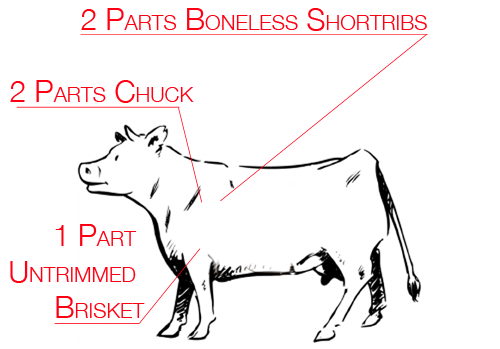
Arriving at a burger with all three of those elements is elusive. The cooking process is one part of it--whether the patty is grilled over open flame or seared on a griddle, how long, at what temperature--and the combination of cuts from the cow is another. Most restaurants use a large quantity of chuck and combine it with cuts like brisket, sirloin, or flank steak. Steingarten eventually decides--after attaching his mad-scientist mind to a series of inquiries and carrying out sundry experiments--that a combination of chuck, boneless short rib, and brisket is best. I did some of my own research and found some intelligence about what the Shake Shack uses in their burgers, including the scoop on Danny Meyer's Blue Smoke burger, which may be the same grind as Shake Shack, as he owns both restaurants.
I set off to the butcher (Los Paisanos on Smith St. in Brooklyn) the morning of the aforementioned burger party. Unfortunately, they have a limited quantity of grass-fed beef available, but all their beef is of good quality, free of any antibiotics and optionally organic. Though I would have preferred grass-fed, this was at least coming from a high-quality, experienced butcher shop.
Once inside, I ordered a random assortment of meats with the butcher's gruff Brooklyn advice, which is to say clipped and unsmiling but ultimately helpful. I ended up with a couple pounds of stew meat (chuck), a couple pounds of sirloin, a pound and a half of untrimmed brisket (the untrimmed part is important, because the fat is important), and a pound and a half of short ribs (boned).
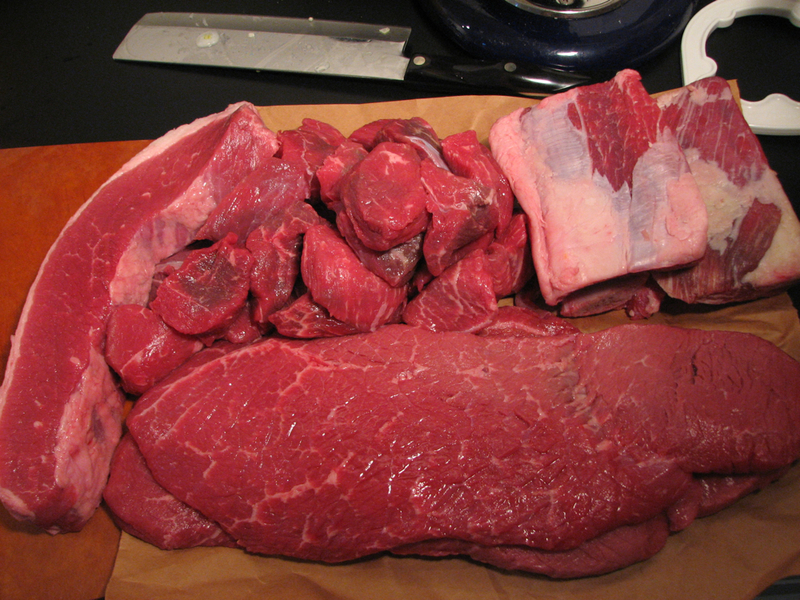
Brisket on the left, sirloin in the front, short ribs in the upper right corner, chuck in the top middle.
A couple hours before grinding, I put all the essential moving parts of my grinder into the freezer so they would be as cold as possible. Then, I cut the meat into reasonably chunks, trimming off any overly grisly parts that would clog the grinder, and separated it into three different burger combinations:
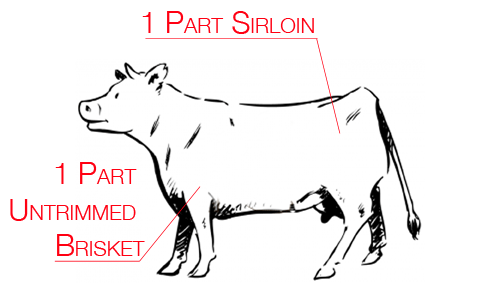
The Shake Shack
The Steingarten
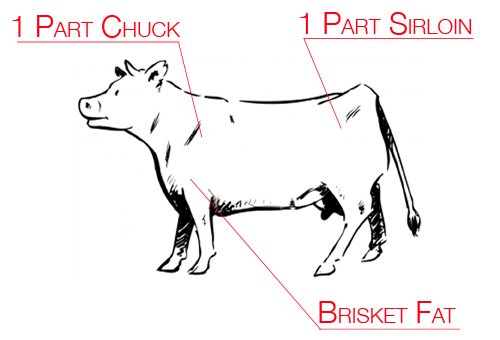
The Classic (i.e., whatever cuts i had left, mostly chuck and sirloin plus fat from the brisket)
I put the various chunks of beef into the freezer; they grind best if partially frozen. The reason everything goes into the freezer is that cold temperatures are paramount--grinding generates heat, and heat melts fat. If this starts to happen, the ratios will be all off and the burgers can get mealy.
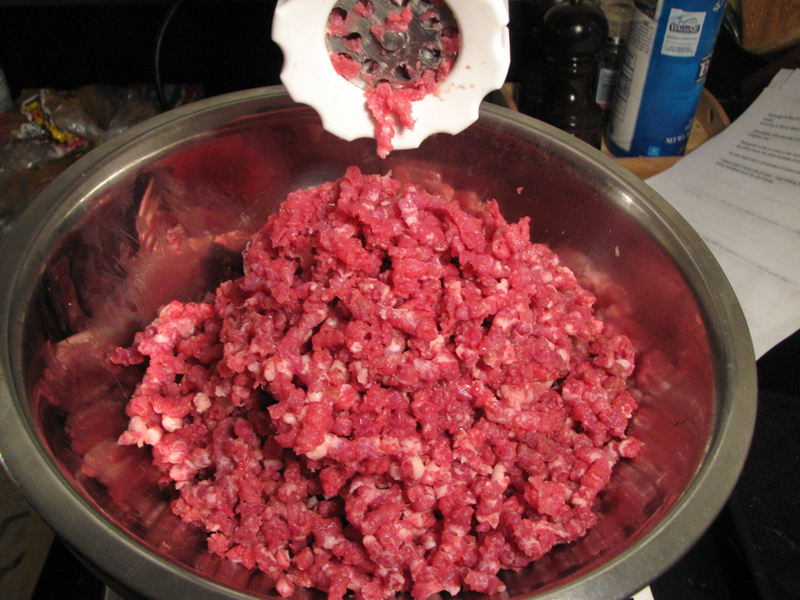
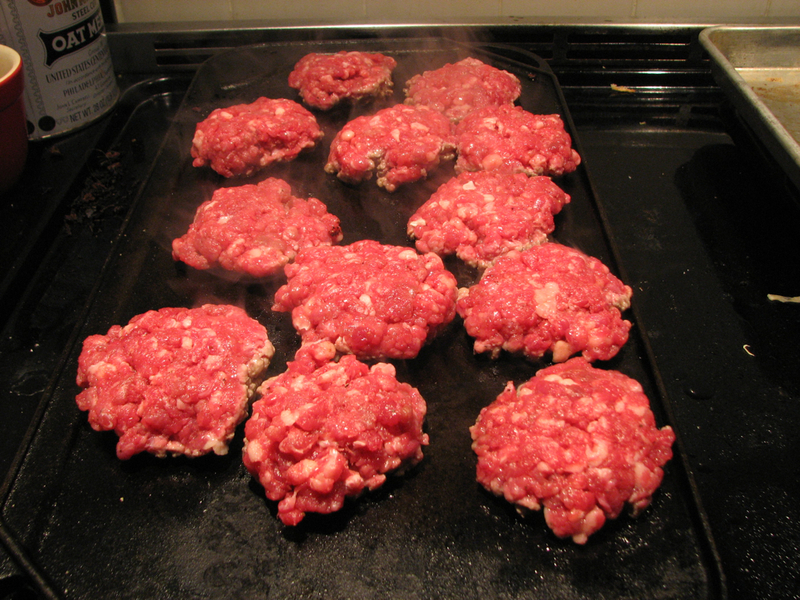
Once ground, I formed them into loose patties--working the meat as little as possible is important so that the end result doesn't get too tough--and seasoned with salt. Each round of sliders were cooked on a medium-hot griddle until medium or so.
For toppings, we had homemade mayonnaise, caramelized onions, avocado, lettuce, tomato, and a wonderful selection of cheeses from our friend Tory: goat cheese infused with garlic and coated in peppercorns, Danish Blue, other melty things I can't remember. For buns, we chose Martin's potato rolls, which are readily available in most grocery stores. They have a good sweetness and are a good balance of sturdiness and softness--the bun should not go soggy under the meat's juices, but not be so hard that the patty or any toppings squeeze out when bites are taken.
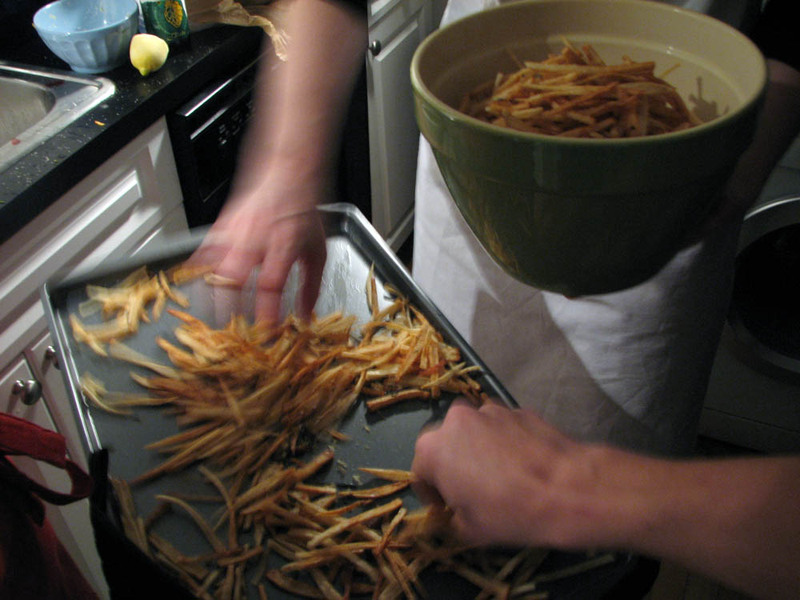
Elin, queen of potato duty, boiled some red spuds for a cider vinegar and dill potato salad, and cut innumerable potatoes with Tory into matchsticks to make shoestring potatoes--the same ones the Spotted Pig serves with their massive burger. The recipe, from Jamie Oliver's latest, is fantastic; you only have to fry the sticks once because they're so thin, making them far less cumbersome than traditional French fries. They come out airy and golden.
The results of the taste test? Almost everyone liked the first burger, the Shake Shack, sirloin and brisket, the best. It was the most straightforward beefy, juicy option. The Steingarten came in second, as it was certainly beefy but almost had too much going on, lacking a clean taste. The final burger nobody mentioned because they were all too full and drunk to say anything. Though I liked it.
The results of this survey are quite unscientific: a couple of problems present themselves. First, cooking 36 burgers does not allow much control over the delicate texture and doneness of each; it's unlikely that the burgers were cooked the same from round to round. And second, sliders are not the best way to bite into a burger and taste that juicy beefiness; they're too insubstantial.
In the end, though, all the burgers were better than they would have been with pre-ground beef, and the process was both novel and delicious. If you don't have a meat grinder, perhaps you have a food processor--that is another tool that works well. Instead of grinding the meat, you'll be chopping it, which is actually the way they used to do it, by hand. Just put the cuts in and pulse it one pulse at a time until the texture is right. Some chefs even prefer this method.
Whatever further adventures my meat grinder holds, I know quite certainly that my mixer will not be gathering dust. Not with summer coming and all those burgers to eat.


Blake, I've said before, will say it again: you rock. I am very jealous of your meat grinder attachment. You can do SO MUCH with it. You can make sausage for one thing. The other thing, equally exciting (at least for us pasta freaks), is that the meat grinder attachment can also be fitted with dies that convert it into a pasta extruder for making dry pasta. Yes, you heard me. You can make pasta with just water, no egg, and extrude your own spaghetti, etc.:
http://www.shopkitchenaid.com/product_detail.asp?T1=KTA+SNPA&HDR=attachments
Then air dry them at the proper temp and see if you can approximate the quality of your Rustichellas!
Back on the topic at hand, burgers. Since I don't have the grinder, I use the food processor pulsing technique which works well. I like to use a little lamb in my mix for it's gaminess. I primarily use chuck and sirloin with that. Sometimes I will throw in a little fatty pork too. Have always wanted to use short ribs because they are so amazingly marbled.
For seasoning, just some salt and black pepper. Don't yell at me: I also use just the slighted drop of the much maligned truffle oil in the mix. Truffle oil is over powering in just about any other application, but I've found that in burgers it's really awesome. Another unconventional thing I do: I add a knob of butter or two to the food processor while I'm pulsing the meat. Does that make me a bad person?
I have often fantasized about what it would be like to use a prime dry aged super marbled rib eye cap to make a burger. Sacrilegious in many ways, but still, I'm sure it would be fantastic...
Question: how did you fry your shoestring potatoes? Did you just do them in a deep skillet? In the pics it looks like they were baked on a baking sheet. Would love to know your tricks.
Posted by: SP | 22 February 2008 at 10:39 AM
Beautiful stuff.
Although if you ever used grass fed beef I highly recommend adding some pork fat, as the above poster suggested.
From previous experience working in a butcher shop that specialized in free-range and organic meats I can say that outside of the NY Strip many of the cuts on a grass fed cow can be extraordinarily disappointing because of the lack of fat, and the ground beef is often simply unusable because of the dearth of grease.
Posted by: hugh | 22 February 2008 at 01:01 PM
Blake, a great post.
As one of the original (read that, “senior citizen”) “burger aficionados” I have been using methods similar to yours for many years. In fact, we bought our KitchenAid nearly 20 years ago in Texas, and are now on our second meat grinder attachment (the first one, after 15 years or so of hard service developed cracks in the plastic body). We always use the “COARSE” blade when grinding beef for burgers.
Other than ground bison meat (we like “Great Range” brand), we haven’t purchased ground meat for over a decade. Under present conditions, one could not GIVE me ground beef from a supermarket.
We have used many different blends of meat for making burger patties, and frankly, it would be difficult for me to say which I liked best.
Another note: we used to soak our beef in lightly-salted ice water prior to grinding. However, recently we changed over to the “partially frozen” meat method of pre-grinding preparation.
A lot of experimentation can be done when grinding meat for burgers: adding a few drops of liquid smoke; a light dash of red pepper flakes; etc.
In my opinion, grinding one’s own meat is not only fun, one is assured of a more sanitary product and one knows pretty much exactly what is going into the ground meat.
Posted by: DocChuck | 22 February 2008 at 01:29 PM
SP: Cheers! Thanks for the kind words. You've blown my mind with the pasta idea--once something is mentioned, I'll inevitably do it. You know what's next? The KitchenAid grain mill attachment. Then I could grind my own flour from wheat berries, to form my own pasta, to extrude it myself. This is a serious rabbit hole.
I debated about using some pork fat but wanted to maintain simplicity for tasting purposes. When you do use pork, what cut do you use? Or do you just purchase fat back from the butcher?
Adding butter is probably sacrilege, but when something tastes right, I say invent a new religion. The only caution about adding things is that we still want a burger, not Salisbury Steak. As far as the shoestring fries, we did them in a 3-4 inches of neutral oil (mostly canola until we ran out and added a little vegetable) in a dutch oven. Follow this link to the recipe for full details. The baking sheet was to keep them warm while we fried in batches.
hugh: I'm surprised to hear that about the ground beef being "unusable," because I've bought ground beef made from grass fed cows before and it was plenty fatty. I know that you are right about grass fed cows being leaner (though higher in good fats like omega-3), but I don't think it's as drastic as you make it sound. But if you worked in a butcher shop, maybe you know better than I do.
DocChuck: Thanks for mentioning that--I also used the "coarse" grinding plate of the two that came with the grinder. I also only ran the meat through the grinder only once because it seems plenty ground when I did. However I've read that two or three times through the grinder is also recommended. I'm sure I'll try that sometime in the future.
Posted by: Blake Royer | 22 February 2008 at 01:54 PM
I'm curious- is this the first grinder you've used? I've got an old-fashioned hand-crank grinder which I use for doing assorted things (country pate, raw cat food, ground meat of assorted varieties). I've contemplated getting the attachment for my kitchen aid, but the expense and the whole "don't fix it if it ain't broke" idea gets me every time. If you have any thoughts on the matter, they would be lovely!
Posted by: ethermaiden | 22 February 2008 at 05:51 PM
This is a really great post, something I could really get into.
I've been using a half chuck/half sirloin mixture that's done me well ever since I've seen the episode of Good Eats.
That picture does exactly what a great picture should do: it makes me hungry haha.
That's always been my big gripe against Shake Shack: they don't have caramelized onions on the toppings list. Although, I still love 'em.
Posted by: Joseph Bayot | 22 February 2008 at 06:37 PM
ethermaiden
I used a hand-cranked mincer (grinder), for many years and, unless you're making semi-industrial quantities, as here (great post, btw), I think it's the better option, not least because it doesn't heat up whatever you put through it, so the mincer/meat doesn't have to be frozen first. A couple of caveats - it should be made of tinned cast-iron, not plastic, and must clamp to the table or worktop (not a sucker attachment, which is too feeble). But, hey, maybe that's just me...
Posted by: Ron Graves, England | 23 February 2008 at 09:23 AM
@Ron: Oh goodness, mine is old enough to pre-date the prevalent use of plastic in housewares. It's insanely heavy, but really works beautifully.
I agree with the suction cup deal- those are useless really.
Posted by: ethermaiden | 23 February 2008 at 10:43 AM
Terrific article!
I made my first home ground burgers to the Super Bowl dinner and it was great. I didn't go crazy with different cuts of meat -- instead I used only one piece of Angus chuck I found on sale. However, the experience and reactions were amazing. I ground the meat just minutes before the patties were plopped into the skillet. Best thing was the knowing what was in there. With ground beef from the store, I always end up with too much fat (or whatever fluids are in the meat) in the skillet; this time it just sat there and did it's thing and I had full control.
Posted by: Christina | 23 February 2008 at 04:23 PM
Blake, grinding your own flour, LOL!!!
Posted by: SP | 24 February 2008 at 11:36 AM
This is the second article of yours that I have found to be of great wealth. If you are thinking of making sausage . . this book is out of print but I found it at the library and gleaned many recipes . " The Homemade Sausage Cookbook by Bertie Mayone Selinger and Bernadine Sellers Rechner
Posted by: Nancy | 24 February 2008 at 07:50 PM
I've not heard of using the grinder to extrude pasta, but there are both pasta attachments and grist mill attachments.
If you have an older Pro 600 series KA it may have a plastic gear box cover, which stands a good chance of cracking and leaking. You will notice the noise level go up a lot.
I will be doing a blog posting on replaceing the cover in the very near future. I.E. when my replacement cover and lube show up.
Posted by: Charcuteire | 25 February 2008 at 09:51 AM
ethermaiden: Personally, this is the only meat grinder I've used. If you already have a grinder, it's probably not worth purchasing this thing--unless you're trying to save space. I will say that this thing worked like a charm, and my arms were not sore the next day. For any kind of quantity, a motor is nice.
Joseph Bayot: Great to know that my third burger round, the chuck/sirloin, is Alton-Brown-approved.
Ron Graves: Thanks for your advice. I didn't think about the heat issue.
Christina: Chuck is a good way to go, as it inherently has a good meat/fat ratio (a good burger is 15-20% fat). I agree with you--more important than the various cuts used, the taste of a freshly-ground burger was above all the most important part. No fluids, water, blood--the meat is pure. It cooks better and remains airy. And tastes amazing.
Nancy: Thank you, I'm glad the article was helpful! I am thinking of making sausages, so I will look into that book. Ruhlman's Charcuterie will also come in handy.
Charcuterie: I have a new model which I think is called "Artisan." I've heard that the gears, which are plastic, are prone to strip with too much work. Some people apparently taking the KAs into machine shops and have the motor replaced altogether with metal gears--that way you can keep the attractive KA exterior with a strong motor inside. This is, of course, the way KAs used to be made years ago. Here's hoping my motor can handle whatever I throw at it.
Posted by: Blake Royer | 25 February 2008 at 10:06 AM
If you are still in the market for a stuffer, I bought this stuffer:
http://cgi.ebay.com/SALE-Sausage-Stuffer-5-lb-Vertical-Meat-Grizzly-NEW_W0QQitemZ290212258372QQcmdZViewItem?hash=item290212258372
It is the least expensive that I've seen, but from looking at pictures of similar models from other manufacturers it is exactly like ones that cost up to twice as much. It works wonderfully. Unless you want something with a larger capacity than 5 lbs, I think this is all anyone needs.
I've stuffed 5 lbs of Andouille in a matter of minutes. Last weekend, I stuffed over 6 lbs or Mortadella into a beef bung. It was easy as pie.
Posted by: Scott | 06 March 2008 at 05:53 PM